Sunday, June 19, 2011

assorted pictures

We've been very busy at work, so busy it seems there's been very little time to focus on much else, so today here's a sampling of a few things we've managed to get finished in the past week or two.

.


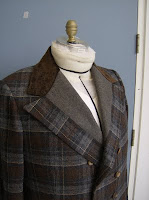
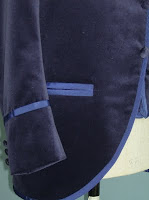
The velvet jacket and waistcoat were cut by my apprentice, Lela, who did a fantastic cutting job for her first jacket project. As it turns out, it ended up being velvet, with bound edges- how cruel is that? Luck of the draw I guess, at least the actor was a pretty proportionate figure since the only other option was the plaid frock coat for a very difficult figure. The velvet suit is an interpretation of a suit Oscar Wilde wore complete with a silk velvet cape- again, difficult work. She also cut a pair of plus four golf breeches and white flannel tennis trousers for the same person.

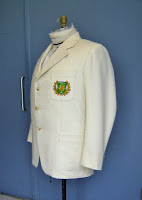
The tennis jacket and plaid frock coat were made for a challenging figure, and the jacket is something I am very happy with. It is challenge to make patterns for disproportionate figures and I have kept my patterns through out the process in hopes that at some point later this year I'll be able to go back and analyse and try to document what I did, so I can apply what worked in future circumstances.
I also cut trousers to go with the tennis jacket as well as plus fours, three waistcoats and a doublet that you can see in an unfinished state here.
I've also been pushed to get things going on our next show at the same time, because when these costumes go onstage everybody on the team needs work in their hands. Life in a rep theatre!

Thursday, June 9, 2011

waistcoat pattern modifications


Most of the time I start out by making a pattern for a design without knowing what fabric will be used.
Usually it is not a big problem, but for some fabrics such as striped ones, you may want to change the dart position once you see the fabric.

It is best to not interrupt the stripes by having an angled dart for instance- so you may want to reposition the dart to be straighter or possibly place it in between a prominent stripe, to minimize the disruption of the stripes.

In the case of this waistcoat, the fabric turned out to be a taffeta, and it had a 5cm wide stripe pattern in black and mauve.
The best choice then was to eliminate the visible dart altogether.

I moved the vertical chest dart by closing it and transferring the dart to another position in the garment. Here it is in the neckline, (where I had already placed a bit of easing), with a small amount in the armhole.
You can see that I have made the dart shorter than the slash, so I have gained a bit in the chest, but that is negligible. There is also a slight gain in the waist because the vertical dart isn't completely edge to edge, but again, in this instance that small amount extra was not an issue.
The amount in the armhole can be eased in a bit or left as is since it is a small amount.

In the end this worked to show an uninterrupted waistcoat front, and all the shaping is hidden from view.

Monday, June 6, 2011

Happy 80th


One of my favourite designers, Desmond Heeley, celebrated his 80th birthday last Wednesday.


I first met him in 1986, he was designing The Merry Widow for the National Ballet of Canada, and I was a junior stitcher, busily stitching the skirts of the the Can-can dresses, which, incidentally, is why I focus on menswear!

The story goes like this: the designs were as only Desmond can draw them, frothy concoctions of ombred silk from yellow to red formed the dress' outer layer, and the underskirts were layers of gold net with rows and rows of ruffles of all sorts of fabrics- from duchess satin to lame- all gathered up and applied in row upon row of colour from yellow to red.
All those ruffles needed to have the edges finished first, and the fabrics needed different finishing techniques depending on what was suitable for each one. I spent a lot of time in the basement of the ballet fighting with an ancient serger with no threading instructions, and then a lot of time gathering these ruffles up. I would tie the gathering stitches off at one end of the hallway at the ballet and patiently gather, gather, gather, sliding the fabric along until I finished the amount set out for me to do. I can't remember how many dresses there were, but it was tedious work, not my favourite job to date and then after I was finished the cutter realized that she had overestimated the amount of ruffles that were actually needed. By double!!

We shared a good laugh over this story when we last worked together.

It was, though, an introduction to working with a theatrical artist in the truest sense of the word. I can't express how fortunate I feel to have worked with him over the past 25 years.
His experiences in the theatre range from working with Peter Brook and Sir Lawrence Olivier, designing the investiture of Charles as the Prince of Wales, theatre (The Old Vic, Stratford, The Guthrie...), ballets(National Ballet of Canada, Houston Ballet, ABT...),and operas (the Met, Vienna State Opera, LaScala...) around the world, to Broadway (Tony awards for sets and costumes).
Speaking of Broadway, he is also nominated this year for Best costume design for The Importance of being Earnest, the show he designed for us, that subseqently has made its way to New York.

You can watch a few interviews with him here.
A fascinating man, a wonderful storyteller and a great theatre artist.


Saturday, May 28, 2011

Downtime

Downtime
Forgive the scarcity of posts lately.
My computer has been having issues over the past few months and I finally took it in to have an assessment only to find I have capacitor problems.
After getting peeved with the hardsell by my local store to just drop a bundle of money on a new computer, I walked.
Posting on an ipad is problematic too so until I resolve this, (either my electronics wiz friend does some soldering, or I buy a new computer),
posting will be delayed.
My apologies,but please stay tuned.

Tuesday, May 17, 2011

18th century toile

I don't think I'm going to get any modern tailoring this season. No wait, I think I have a set of plus fours and a 1930's tennis jacket and white flannels to do when the fabric arrives.
In the meantime......
The next assignment harkens further back in time to the mid 18th century, and since our designer was coming in from afar this week, I had to switch gears and get together a toile fitting to get an idea of where we are heading for shape and fit.
This wasn't too bad a start, I had never made anything for Mr. J seen here. He is quite tall - about 6'4" and has a 10" chest to waist drop, (a challenge) so it was a good first fit. I have to shorten the coat and change the waistcoat a bit and deal with a few more fit issues especially on his right side (DRS) before I will chop into the real fabric. Then I need to add a lot more volume in the pleating and will have to figure out what kind of interlining I will need to use to get the coat to bell out through the skirts.

That's for a bit later in the month, so all I can do for now is make some notes, hang it up and get back to the current lot of work.

Monday, May 16, 2011

mondays


Some days are more difficult than others. Monday morning should not be accompanied by plaid. Especially an uneven plaid. Especially an uneven one directional plaid. Especially an uneven, one directional plaid with a 4"x 4 1/4" pattern repeat for a frock coat on a size 52 man.

Never mind. The colour is totally off in this picture. The fabric is really a brown and black background with a double grey stripe on two sides of the yellow bordered rectangle.

After much consternation, I made some decisions.
Which way was up? I ran the grey stripe downwards.

Could I use both sides of the fabric as the "right" side so as to have a mirror image symmetry in cutting? Yes I can, and did.

Which part of the plaid should be prominent at the CB? Not the bright yellow part of the pattern. I picked the centre of the rectangle, so the grey stripes book-match mid back.

What about the pattern at the CF? I picked the same mid point of the rectangle but at the front the brown areas will book-match.

Should I close the chest dart and move it to a lapel dart? Yes. What you see in the photo is the preliminary closing of the dart and the resulting opening into the gorge line. I shortened the lapel dart so it will be hidden. I do gain a bit of fabric mid chest but that may work in my favour- we'll see. Less pattern interruption at the waistline.

Should I wait and cut my sleeves in muslin? I think so. I'm not that brave on a Monday morning, or afternoon it turns out. Tuesday could be an option.

Yardage- it took 2.8m for everything except sleeves and top collar. I'm pressing for a solid contrasting top collar fabric. There's a plaid limit somewhere! I like to keep track of yardages for future references.


Book-match. Don't words seem odd when you use them a few times too many? Just in case I am confusing you it is a term used more often in woodworking, but it applies here too.
Book Match: The most commonly used match in which every other piece of veneer is turned over so adjacent pieces are opened like adjacent pages in a book, creating a mirrored-image pattern at the joint line and yielding a nearly continuous grain.


Sunday, May 1, 2011

19th century waistcoat finished


Here are the finished photos of the waistcoat that I posted about here.
I am very happy with the way it turned out. If I had to change anything for improvement, I would deepen the shawl collar at the back so the neck edge was completely covered.

Top stitching by machine is not what I usually do on period waistcoats but it was a designer's request for that detail and I have to say I like the effect. It is like adding a line of trim, it delineates the edge, drawing your attention but not in a loud way.

We had inserted a "slip vest" of blue silk, which again draws your eye to the neckline and delineates the waistcoat from the shirt and cravat, and picks up on the colour in the coat.
It is always interesting working with designers for the first time and I have to say that this one has a wonderful and sure eye for colour combinations that are so appropriate for each character.
It is one of those things in design that if done correctly is almost imperceptible to the average audience member- you just feel that it is right. When it is wrong, it feels off, but not many people know exactly what isn't working.

anyway, that is all I have to say today.
I'll post some more finished garmens later but this has been a long and stressful week due to many things.
Upcoming tech dress, long distance project alterations that were required, and most sadly the death of an old friend and colleague after a prolonged battle with cancer.

Til later.