
 Posts
Posts


It has come to my attention that a description of the various jobs in the theatre wardrobe is in order.
I am referring to the large theatre setting and to some degree regional theatres in Canada. There is likely some difference in other countries, and some differences for film and television work.
So, lets start with the costume designer.
Contrary to what most people may think, the costume designer doesn't make the costumes.
The costume designer is most often chosen by the director of the particular show. Designers may be suggested by an artistic director or production manager, based on the designer's previous work or a designers affinity for a certain style of design that may be just the right thing for the show in mind.
As such, the designer has to be a conduit for the director's vision for the show.
People Skills. The deigner must have good interpersonal skills to work with many people; from the director, the actors, stage management, publicity, the wardrobe, to the fabric store employee.
Research.The designer must be able to read the script, making note of all the different characters and their possible costume changes and requirements in accordance with the directors vision, the plot, and the budget.
They also must research the era the play is to be set in, the clothing styles, the social etiquette, the historical goings on that may need to be reflected in their design.
Drawing. A designer needs to be able to convey the idea for each character in the show in a sketch. It is how they communicate all of the research and discussions that they have done up to this point. This sketch is what they will present to the director to illustrate how the characters will look and fit into the overall vision.They need to present colour drawings or swatch fabric samples to illustrate the colour palette.
The drawing is also what is given to the costume cutter or tailor so the design is interpreted into a pattern which can then be made up.
They have to make decisions not only on the main costume pieces but also the trimmings, undergarments, shoes, hats jewellery, eyeglasses, hairstyle, and makeup.
Sourcing. Designers need to be able to find fabrics for costumes to be built, purchase clothing online or in stores, or find rental costumes. In some cases, designers must also know a variety of costume makers who can work on their project, if there is not an in house team. If they are purchasing fabrics they need to have some feel for how fabric handles and what kinds of fabrics are suitable for different garments.They need to have a basic knowledge of yardage requirements for different garments.
Fittings. Designers need to be able to make decisions in fittings with the cutter in regards to style lines and proportions, or if using stock or bought pieces, be able to decide if they fit into their overall plan. They have to choose shoes, accessories, trimmings, jewellery etc.
They also need to be able to interact at the fitting with the actor and be able to convey the vision of their design and speak to any concerns the actor may have.
Rehearsals. Designers often attend rehearsals so they can monitor any changes the director may be making or if the staging will require a change in their design. They will watch the dress rehearsals and give notes afterwards for any changes that need to be made.
Budgets. Designers usually have to keep track of the money they spend, both in materials and sometimes labour costs as well.
Organization and time management. Designing a show is a lot of work, and the more organized a designer is from the start, the less stress getting to the end result. There are always delays and setbacks, which cannot be anticipated so organization is the key to keep from getting bogged down or impeding the process.
Hmmm.....I am sure I have missed a few things so I may add them in as I think of them.
The next job description will be that of the Cutter.
Friday, March 22, 2013


Saturday, March 9, 2013
Designer decisions
In the early days I thought I wanted to be a designer. I guess that is because no one talks about all the other jobs like seamstress or tailor or pattern maker or cutter, so they are invisible. The designer gets all the glory!
It is a very collaborative process and as I discovered, I was much more suited to the technical side of things.
So, even if the designers get all the glory and recognition, they also have to make a lot of decisions that the very same public never think about because the process is so hidden.
In the case of a period show, the decisions increase at an exponential rate. It isn't enough to just choose the fashion fabric and a lining anymore. Some designers are very specific about all the details in their drawings, others are not.
Take for example this doublet. I cut a half in muslin to illustrate some of the answers I needed to move forward.
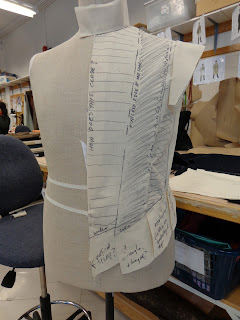 It is supposed to look like two garments but really is one. When I first talked about it with the designer, I made a few notes but didn't have much time for in depth thought about how it all would work, but once I started into making the pattern, I had a lot of questions.
So,
1. how does this garment close?- it wasn't indicated. options are CF meets edge to edge and it closes with hooks and loops, it has functional buttons (need buttons) and holes, or it has a faked closure like a zipper underneath and a decorative placket (need decor trim or such) to disguise the zip.
2. the centre front panel will either extend fully under the front or will just attach into one of the vertical seam lines- I think less bulk is better, so into a vertical seam just in front of the armhole.
3. that means the second panel has a free edge so that means it needs to be lined in something(need lining choice), and what about its finished edge? Does it need something like a trim or a piping (need trim or fabric)to help define the edge and further give the idea that it is a faked separate garment?
4. speaking of vertical seams, the fabric is a brocade. Those requested vertical seams are going to get lost. So I mean if you are making a design feature of them, they need some definition- and what is it? piping?(need fabric) if it is trim, has it been chosen?
5. that leads to the tabs at the waist. They need a lining fabric. How are they to be finished? Plain and bagged out? piped (need fabric) or bound edges(need fabric)
6. do the tabs overlap at the waist or meet edge to edge?
7. is there a centered tab at the centre back or do two tabs meet?
8. Do you want the body seams to co-relate to the tabs? that decision dictates the seaming position on the body.
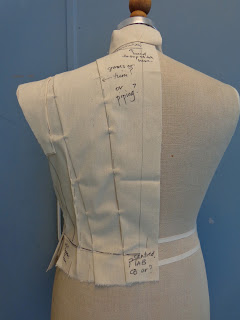 9. if the over garment doesn't come right up to the neck point, as it didn't in the sketch, I have to show a bit of the under garment fabric at the back neck area. I also have to be able to attach the two things together somehow, so that means either making the underpiece like a yoke that I can attach to the seaming or I have to attach it around the neckline so something like a piping edge would be useful (see point 3)
10. the shoulder wings- are they short like this or do they continue all around the armhole as they sometimes do?
11. Do the wings get any kind of edge finishing? Same as the waist tabs?
Have I missed anything?
oh yes, things I don't have pictures of
12. sleeves-do they have a decorative treatment on the seams? (need decor)
13 do the sleeves close with buttons(need buttons) or a plain placket.
14. are there decorative cuffs? (need fabric) do the decorative cuffs have any lace trim?(need lace)
15. is there a decorative collar or ruff? (need fabric, and possibly lace)
Wait!
16. a cape too. With a collar. Is it lined?(need fabric). Need ties (find cord of some kind)
After I get all these decisions, I still have to make and fit a mock-up, make fit and stylistic changes to the pattern that are required, then determine the support needed for the fabrics the designer chooses, all before cutting it out and having it made up.
So it isn't as simple as it looks and you can multiply these decisions by X number of costumes and then some as the ladies wear will often have a few more decisions to be made concerning understructure to give the correct silhouette and probably more decoration.
Then there are decisions to be made for wigs and millinery, footwear and jewellery and somehow blending in stock costumes to the design.
This can be overwhelming, especially to designers who have never dealt with a large period show.
They work hard for their recognition and glory :) wouldn't you say?
It is a very collaborative process and as I discovered, I was much more suited to the technical side of things.
So, even if the designers get all the glory and recognition, they also have to make a lot of decisions that the very same public never think about because the process is so hidden.
In the case of a period show, the decisions increase at an exponential rate. It isn't enough to just choose the fashion fabric and a lining anymore. Some designers are very specific about all the details in their drawings, others are not.
Take for example this doublet. I cut a half in muslin to illustrate some of the answers I needed to move forward.
 It is supposed to look like two garments but really is one. When I first talked about it with the designer, I made a few notes but didn't have much time for in depth thought about how it all would work, but once I started into making the pattern, I had a lot of questions.
So,
1. how does this garment close?- it wasn't indicated. options are CF meets edge to edge and it closes with hooks and loops, it has functional buttons (need buttons) and holes, or it has a faked closure like a zipper underneath and a decorative placket (need decor trim or such) to disguise the zip.
2. the centre front panel will either extend fully under the front or will just attach into one of the vertical seam lines- I think less bulk is better, so into a vertical seam just in front of the armhole.
3. that means the second panel has a free edge so that means it needs to be lined in something(need lining choice), and what about its finished edge? Does it need something like a trim or a piping (need trim or fabric)to help define the edge and further give the idea that it is a faked separate garment?
4. speaking of vertical seams, the fabric is a brocade. Those requested vertical seams are going to get lost. So I mean if you are making a design feature of them, they need some definition- and what is it? piping?(need fabric) if it is trim, has it been chosen?
5. that leads to the tabs at the waist. They need a lining fabric. How are they to be finished? Plain and bagged out? piped (need fabric) or bound edges(need fabric)
6. do the tabs overlap at the waist or meet edge to edge?
7. is there a centered tab at the centre back or do two tabs meet?
8. Do you want the body seams to co-relate to the tabs? that decision dictates the seaming position on the body.

10. the shoulder wings- are they short like this or do they continue all around the armhole as they sometimes do?
11. Do the wings get any kind of edge finishing? Same as the waist tabs?
Have I missed anything?
oh yes, things I don't have pictures of
12. sleeves-do they have a decorative treatment on the seams? (need decor)
13 do the sleeves close with buttons(need buttons) or a plain placket.
14. are there decorative cuffs? (need fabric) do the decorative cuffs have any lace trim?(need lace)
15. is there a decorative collar or ruff? (need fabric, and possibly lace)
Wait!
16. a cape too. With a collar. Is it lined?(need fabric). Need ties (find cord of some kind)
After I get all these decisions, I still have to make and fit a mock-up, make fit and stylistic changes to the pattern that are required, then determine the support needed for the fabrics the designer chooses, all before cutting it out and having it made up.
So it isn't as simple as it looks and you can multiply these decisions by X number of costumes and then some as the ladies wear will often have a few more decisions to be made concerning understructure to give the correct silhouette and probably more decoration.
Then there are decisions to be made for wigs and millinery, footwear and jewellery and somehow blending in stock costumes to the design.
This can be overwhelming, especially to designers who have never dealt with a large period show.
They work hard for their recognition and glory :) wouldn't you say?
Monday, February 18, 2013
Both ends of the size spectrum

Last week I was able to get a couple of fittings on the Bekishe coats that we are making.
These are traditional long coats traditionally worn at weddings.
The designer wanted very soft construction and not necessarily a perfect fit, so these will get some breakdown later. They have only a single layer of hymo for support, no shoulder padding and they will only get a half lining to keep everything soft.
I was happy that they worked out so well. though one could argue perhaps too well, since the fit was pretty spot on.
We have four of these Bekishe and two of the Kapoteh to make in sizes from 36" chest to a 52" chest.
When I am cutting multiples, I prefer to have one prototype fitting to see if I have interpreted the style to the designer's satisfaction. Unfortunately, we didn't have that opportunity, so I was cutting right into fabric hoping that both the fit and the style were OK.
I don't grade my patterns up or down to get the different sizes. I just draft each of them as I go. Grading isn't a skill that I really have- I understand the premise but I really don't have practical experience with it. I tend to draft one pattern in which I work out the proportions I think I will use on the other sizes, ( the amount of waist suppression, the size of the panels at the waist, overall length, the amount of flare in the skirt) make notes and then draft each one separately. Drafting new takes less time than trying to teach myself a new skill set that may or may not be the best choice in the situation.

In the top photo, I am dealing with the smaller end of the size range and the bottom photo shows the larger.
The gentleman in the top photo I had never seen before, I just got his numbers and a photo to work from so I felt very gratified to have such a good fit.
In the bottom photo is someone I have made for before, but hadn't done anything like this for him.
(you know, I keep certain patterns but honestly I rarely get them out and use them again, not that an eighteenth century coat pattern would have made life any easier)
The challenge for me was to try to quantify my draft in a larger size.
Most drafting systems are based on a 5'8"tall man with a 36" or 38" chest and as you draft for sizes past about a 44" chest, the formula starts to go wonky. Things like the depth of the armhole and the width of the back neck.
That's when I think it comes in handy to be willing to adapt and adopt bits and pieces of knowledge as you go. It also helps to have a lot of experience, to lessen the worry when cutting right into the fabric.
I do wish I had more time to analyse things like this while at work, but for now I just try to scribble notes on the pattern as I go and hope that at some future time I can go back and look at it, and it will make sense.
Tomorrow I have one more to cut out in fabric, and the linings and bits of the three I fit this week to cut so they can be finished.
Then I can start my patterns for the next show. Onwards!
Tuesday, February 5, 2013
Shirt Rant
Shirt Rant
I have been lurking for a while in an mens internet clothing forum and it is an eye opener in many ways.
Since I am concerned in my day to day work with theatrical tailoring, most of the styling I deal with is more period than current.
That isn't to say that I have had my head buried in the sands of style.
I have been watching the modern suit and it's changes.

How short can they make those jackets? How narrow can they make the trousers? How ill fitting are most of these suits on your average guy?
It isn't limited to the suit either. The shirt, once a comfortable garment is now tightened and modified without consideration to the person wearing it or its function. Worse, it is marketed as something you can custom order to your own measurements. Just fill in the handy chart. Now there are masses of guys who have been measuring themselves (a bad idea) and sending in orders for slimmer and slimmer fitting shirts only to find they cannot bend their arms or wonder why there is still some excess fabric not plastered to their bodies.
On the plus side, the trend of the suit and learning about fit and clothes that go beyond a pair of sweats or jeans and a t-shirt is commendable.
But, these guys have little idea how a garment should fit, no idea of the limitations of fit especially in the online MTM business, yet they order anyway only to bemoan the ill fitting product they receive in the mail. They just don't know what they don't know. If you know what I mean.


I have been tempted to put in my two cents when I see things like this, but I just don't think I have the time to try to explain and enlighten the masses. Heck, I can barely find enough time these days to post on my own blog!
So, shirts:
A shirt is a washable garment to wear next to the skin that, historically speaking,  that acts as a buffer between the body with its oils and perspiration and the more expensive and less washable over garment.
It provides both coverage and style.
A shirt should have ease through the body. (A shirt is not a fitted bodice)
How much ease? Well a close fitting jacket is typically 4" larger than the chest measurement overall, so a shirt should have more ease than that. I have seen drafts with as little as 6" of ease total to 10 or 12" and more of ease.
The depth of the shirt armhole is generally lowered to allow for an easier fit.

The rule is:
The smaller a garment gets, and the less ease it has, the  more it needs to be shaped to follow the three dimensionality of the body.


The shirt has limitations in fit.
 The fit is achieved through the seams and occasionally, vertical darts in the body. The front of a shirt is straight. The neck point therefore is much closer to the CF line than a jacket neck point is. In a jacket, the shifting of the neck point away from the CF is basically creating a dart in the front. This, among other things, allows the armhole to be closed down in size, and be shaped more like the body it is on.
Simplistically speaking, in a shirt, some of the armhole size at the front  is reduced by sloping the shoulder  but there is a limit to how much can be taken out before it causes a problem fitting the actual shoulder. Surplus fabric could be taken out below the pecs by a vertical dart, but unless there is a dart or a seam going either into the armhole or up through a front yoke or bib front,  a shirt will naturally have some excess fabric in the front armhole.

This is generally not a problem until you start reducing the chest ease excessively, and raising the armhole.

The centre back of the shirt is cut on the straight. There is usually a yoke that allows for some shaping in the back over the blades. The armhole can be reduced in the back by shaping the yoke seam, as well as by some slope of the shoulder. There is a limit to the amount of fitting and armhole reduction here as well, because in men, the upper back is often more developed than the chest. There is also a range of motion that must be accommodated . Movement of the arms is generally forward, expanding the muscles of the back, and this needs to be allowed for.
A shirt will naturally drape off the upper back and the fabric will not sit sucked up against the body at waist level.
A shirt can have vertical darts under the blades to reduce excess fabric in the body and provide a cleaner fit. I have read over and over the advice to just take in the side seams. This is not going to do it, especially if you have prominent blades or a developed upper back.

The last seams available for shaping on a shirt are the side seams.  You can use them to reduce from the circumference of the chest to the size at the waist but again, only to a certain degree. You have to increase back out over the hip though. If the hip is too tight, the shirt will naturally ride up and blouse out at the waist.


What about armholes and sleeves? Traditionally, shirt armholes were straighter than jacket or vest armholes and the sleeves were cut with a flatter and wider sleeve crown.
A shirt usually allowed the arms to be raised close to horizontal without pulling the sides up.
If the ease in the body is reduced, the armhole is both smaller and more shaped. When this is combined with an attempt to reduce the armhole size by other means, the sleeve is now in a dilemma. It still needs to be wide enough to encompass the arm and the expansion of the muscles in movement.  It still needs to allow for some raising of the arm so it still needs a relatively flatter crown to go into an increasingly un-shirtlike armhole. What happens then is that the sleeve looks strangely bunched up when in a resting position. If the sleeve shape is modified to be more like a fitted bodice, or jacket, you limit the easy raising of the arms.
It just feels like a no win situation doesn't it? I don't think the MTM shirt sellers can really be totally blamed because they are just working with the numbers the well meaning customer inputs into the system. You just can't manipulate the pattern randomly either, it is much more complex than for example reducing the size at any one point. Perhaps they should be defining the fit parameters and what they can modify to an individual and maybe avoid the returns and remake requests they must get on a regular basis.
My thanks to the anonymous photo donors for their willingness to ask for advice online.
End of rant.
Wednesday, January 16, 2013
Almost finished or A rack of suits

Oh, we are almost finished the project!
I started bagging up the suits today. I tagged them and double checked everything.
It is very gratifying to have accomplished all this work.
We made five complete tail suits, which included altering the shirts, adding dance briefs and quick changing the bow ties by snapping them to the collars.
We also made 9 other suits, five of which were three piece suits, plus an extra pair of trousers.
We put period collars on the shirts, and quick changed some of them as well.
I put the last eight buttonholes in today as well, so that is done too.
I need to box up the remaining fabric, finish up my paperwork and arrange delivery. I am looking forward to seeing them worn when the show techs.
Next week I start back at my regular gig, and I will be working on three very different shows: Fiddler on the Roof, Mary Stuart, and Blithe Spirit. It should be interesting, and I will keep you posted.
Saturday, January 5, 2013
Reece industrial buttonhole

I am starting out the New Year with the end of the current project in sight. I have to say it was difficult to peel me away from taking a well deserved break over the holidays. In fact finishing the project was looming ever larger in my mind to the point where I was feeling overwhelmed with the thought of getting back to it.
In the end, once I started it wasn't as big as it had become in my imagination.
Today, for instance, I headed over to Evan's place to deal with the buttonholes. I have about 76 buttonholes to put into the various jackets and waistcoats, and I am going to use his Reece industrial buttonhole machine to do them.
I remember the days when we had to make the buttonholes by hand, and as satisfying as it is to do that, it takes time- probably a good 15 to 20 minutes per buttonhole once you know how to do them and you get into the groove. Luckily, we have acquired a couple of these machines at work, and they do a very good job and save a vast amount of time and money. Evan has invested in one of his own, which is the one I will use for my job.

This machine will make either a regular keyhole buttonhole or an "eyeless" buttonhole. It uses two threads and a gimp, and stitches a knotted chain stitch over the gimp.
The buttonhole is marked on the wrong side of the garment- usually by chalk marking a lengthwise guideline and a cross mark for the centre of the "eye". I have thread marked the placement on these white epaulettes, as I don't like to mark up white fabric with a coloured line. The area around the buttonhole is stabilized by hand basting, after the marks are made.
The size of the buttonhole is regulated by a sliding mechanism with a wing nut on the right side of the machine bed. It will make buttonholes from approx 3/8" up to 2 1/2" long.
The gimp and lower thread feed up from the underside, and the needle thread is on top.
There is a cutting blade that automatically cuts the keyhole and a portion of the length, which I asked to have removed in case I don't get the positioning correct the first time. I can easily unpick the correct thread and pull the chain stitch out quickly in order to redo the buttonhole again.

The spreaders engage and pull the fabric taut, as the stitching starts. The upper portion of the machine moves from front to back and returns as the stitching is complete. It is loud and fast. Under 5 seconds per buttonhole I would say.
Once it is finished, the clamps release and you pull the needle thread gently, then clip it and pull the garment out, catching the lower thread and gimp under the holder and then cut the thread, leaving a tail of threads hanging off the garment and also on the machine.
All that remains then is to secure the threads and remove the basting, cut the hole and sew on the buttons.
So, I did some today, and I will go over and do the rest on Monday and we will be 76 steps closer to finishing.
Wednesday, December 19, 2012
year end thoughts and photos
Year end? Where did the time go?
I had planned on doing some posting while I was guiding Lela through drafting and fitting body coats, but it fell by the wayside due to her mother's illness and subsequent passing. We did get through quite a lot of drafting and fitting but I didn't have the wherewithal to document it as I have done in the past.
These are a few of the last things we've been working on- the tailcoats with the Ballet gusseted sleeves- they don't hang as cleanly as a regular sleeve it is true but you can raise your arms! The fitting I did last week was for these checked trousers with a dark grey jacket. I don't know why I like the checked trousers so much, but I do! I guess they feel rather cheery and they stand out compared to the more sombre grey suits that we had been making.


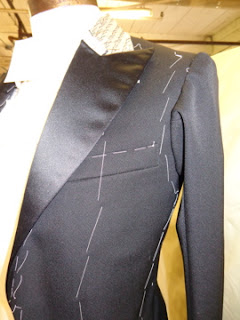
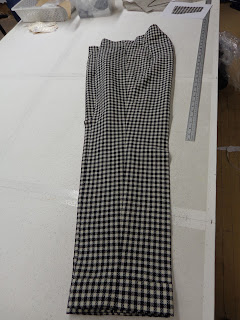
On Friday, we collectively decided that it was time to put down the shears and needles for a break before Christmas. I have 76 buttonholes to do (by machine of course) so I got all those marked and basted and ready, planning on getting over to my colleague's place to have them done when I was just hit by fatigue and I gave in to it. They can wait until the New Year. I just need a break, so I am taking one, since it has been a very busy year so far.
I wish each and every one of you a Merry Christmas and all the best for 2013!
I had planned on doing some posting while I was guiding Lela through drafting and fitting body coats, but it fell by the wayside due to her mother's illness and subsequent passing. We did get through quite a lot of drafting and fitting but I didn't have the wherewithal to document it as I have done in the past.
These are a few of the last things we've been working on- the tailcoats with the Ballet gusseted sleeves- they don't hang as cleanly as a regular sleeve it is true but you can raise your arms! The fitting I did last week was for these checked trousers with a dark grey jacket. I don't know why I like the checked trousers so much, but I do! I guess they feel rather cheery and they stand out compared to the more sombre grey suits that we had been making.


I wish each and every one of you a Merry Christmas and all the best for 2013!
Subscribe to:
Posts (Atom)
