Sunday, November 15, 2009

corrected jacket pattern


I took a day off from my other project in order to proceed with correcting the jacket pattern from the toile fitting.

I usually put the toile on a stand- sometimes padding it up if needed to be able to see it hanging as it did in the fitting.
I measured and transferred the alterations to the pattern. (Sorry I forgot to take a picture of that)
In this case, I then made a clean pattern from the rough one I created for the toile. Checking and rechecking, to make sure the resulting shapes look good, grainlines are indicated, and that the seams will sew together correctly resulting in smooth flowing lines.

At this point I can cut a jacket in their choice of fabric- which I have and yesterday delivered it back to Silvia for construction. There will still be minor changes as every fabric behaves differently and a shell fitting doesn't exactly replicate what the final jacket will be, but it hopefully will have fewer alterations to deal with now.
They want something soft for this first jacket, so I was given a dark charcoal wool- a bit too light weight I thought, but it was something they could afford and it will give him a jacket to wear before Christmas.

Now I return to the other project which is coming along on, and needs to be delivered in two weeks or so.
In the meantime, my to do list:
Speak with a couple of other people who were interested in having suits made
Try to get a trouser pattern made for a lady client
Prepare for a career day talk at the local high school
Look at some fabrics for work next year
Deal with my landlord and a leaking roof at my studio space
Fit the jacket I've posted about
Gather my remaining wits about me
Relax?


and finish painting my kitchen!

Friday, November 13, 2009

jacket toile


I cut a toile (mock-up) of the jacket in an inexpensive wool blend fabric I found at a local shop. It needed a bit of support so I interfaced the fronts with some leftover suit fuse that I had in stock.

Silvia put it together ready to fit. It's only a few hours to put a shell like this together- which I feel is time well spent when dealing with more difficult body shapes.
The front edges were just turned back, the collar was literally just a bias cut collar of the same fabric with the suit fuse for some stability. The sleeves were made up from a stock pattern that I already had in the approximate armhole size, but not basted in. Very thin shoulder pads were tacked in place.

The purpose for this was to just get a shape together to fit and make pattern adjustments. The clients hadn't even looked at fabrics, or thought much about the styling they were after except that it be single breasted and have a vent in the CB. I like to be able to pin on a pair of sleeves after I fit the body- just to give the client an idea of what it will look like- many people find it disconcerting to try to envision a final product without sleeves.

Obviously from the pinning you can see that I had to pin out at the shoulders(sloping).
I had a bit too much length through the front( as I suspected).
I needed to pin out a dart of about an inch of excess width at the front hem that terminated just below the chest. The back of the jacket seemed to sit well although I had to reduce the cross back width that I had allowed for. I will reshape the armhole all round.
The only other issue was his regarding his left shoulder. Due to a deteriorating shoulder, the ball of his shoulder was protruding in front and I will have to make allowances for that to be accommodated.

Next stage: pattern corrections from the fitting.

Wednesday, November 11, 2009

custom jacket pattern


OK, I wish I had more time.
Ten weeks of kitchen renovations and cooking outdoors takes a toll on time to blog.
A big project that involves administration, buying, cutting and sewing at the same time takes a toll on the time to blog.
What else? well how about sewing tests - I do the sewing tests for prospective employees which involves cutting bodices and then guiding the candidates through an afternoon of sewing, instructing, correcting, taking notes and rating their performance for management. More time.

Add in a private client and I have barely time to function.

Oh well,
I have had the pattern made for a while and have had a fitting in a mock-up and I am at the point of correcting the pattern and cutting in the real fabric, but I still haven't had time to sit down and write something intelligent to explain the pattern making process for this gent. It is generally so much easier to do than describe how to do things! but I am going to try with the few lucid thoughts I have available right now.


The back is a fairly standard shape-FYI: this version of the pattern doesn't have any seam allowance on the shoulders or armhole-I'll explain later.

There are many ways of approaching the front to accommodate this man's shape- I know- and this is just one way of thinking about it.

I have drafted the front, raising the neck point and shoulder equally above where they normally would be. How much? Well, I use the nape to CF waist measurement I took on the client. I rough in the normal front shoulder line in the draft to start.

The natural waist on my pattern is about 1 inch to 1 1/2 inches below the drafted waist line. I measure the back neck, then place that amount on the natural waist at CF and measure up the full amount to the position of the neck point. This gives the extra length in the front which is needed. I construct the new shoulder line in parallel to the "normal". I continue with the gorge line and lapel from there.
I don't however, need all the extra armhole size, and I can remove some of the excess now in the armhole by darting into the gorge line, as well as down through the body as I close out the excess in the armhole.
I measured the waist of the pattern and decided that I still needed to add width for his belly, so I cut open the pattern from hem to mid lapel and added more.

The problem with dealing with a belly is, as you add width where you need it, you gain an excess of fabric below the belly which needs to be reduced- hence the dart into the pocket. I cut into the pattern at the pocket line, then took out the excess (determined by eye) at the hem, thus opening up the pocket line into a rather large dart. (Plaids would not be good here)
I knew from fitting one of his own jackets on him, that I could pin out a good inch at the pocket to correct the hang of the jacket, and I have at least that in the pattern above. It may prove to be too big a dart for its length, but I will leave it for now.

I think I may have been a bit generous with the front length, (and I was proved correct in the fitting) but I went forward into the toile thinking that it is much easier to pin out excess, rather than either guessing how much more is needed or undoing the shoulders to drop them at the fitting.

Next, the toile.


Saturday, October 10, 2009

jacket pattern

I will start by giving you the information that I have to make a pattern for this client.
Firstly, he is of retirement age.
Height 4' 11",
neck 14 1/2"
chest 36 1/2"
waist 37 3/4"
hip 38 3/4"
XB 13 3/4"
nape to CF waist 22"
back length 15"
nape to wrist 30 1/2"

So, as you can see, he is not of average proportions, he has a belly by virtue of a health issue- nothing more- he has had serious shoulder surgeries.
He has a difficult time buying anything that fits. He had a suit "custom made" not long ago in Toronto, which sort of swamped him, and did not have enough correction for his belly.

To begin with, I drew a little sketch of what need to be changed from the "average" suit draft.
(I have to post photos because I can't hook up my scanner to this computer.)

One: most modern styled drafts will produce a wide back and shoulders. I measured his custom suit which had a cross back measurement of 17 1/2" yikes- no wonder he looked a bit swamped in it.

Two: his waist measurement- he has a belly that is bigger than his chest measure. The suit jacket he tried on billowed below the belly- I could pin up at least an inch of body length at the back of his hip pockets.

Length: I like to get a measurement from the nape of the neck to the CF waist on the person. I use it when drafting to ascertain the placement of the front neck point above the back neckline- this affects the balance of the coat.

People are three dimensional- whenever you encounter increased size around the body it corresponds with an increase in length. Period. You have to allow for it otherwise you will have a problem with the balance of the garment.

I am going to work through this and you may think that I am going about it in a strange way- but it is the way I am going to approach it. I like to understand why things are the way they are, so I confess that I tend to alter and adapt systems that tell you what to do but don't explain the reasons for doing it.


Wednesday, October 7, 2009

goodbye Douglas Campbell

This autumn has been too full of deaths of people of my friendship and acquaintance.
Today we say goodbye and farewell to an icon of Canadian theatre, Mr. Douglas Campbell. His image stares out at us at work from a variety of photos over the years, from arriving on the train with his wife and children to the cricket team's annual photo.
I first met Douglas in 1990 when I went out to Theatre New Brunswick to work on A Christmas Carol. Douglas was Scrooge, and what a Scrooge he was! What a voice and presence.
He was frightening in his gruffness and BAH humbugs then was utterly transformed as he was redeemed at the end, childlike, gleeful and mischievous.
I had many opportunities in the intervening years to work with him as he acted-and directed. Most notably to me, I worked on Oedipus Rex, a role he performed in 1954 (I believe) and then directed in 1997 with his son as the lead. Tanya Moiseiwitsch designed the original and at an advanced age returned to guide the design through the remount. I have some cherished Polaroids of Ben in costume as Oedipus with Douglas directing at the photo call, with Tanya in a wheelchair off to the side watching over it all.
That year,1997, he lived next door to us, my daughter was not yet a year old - she found him very amusing- and we got to know him a little more- a kind hearted soul who once even brought in our laundry while we were at work and rain was threatening.
A legend of Canadian theatre has gone and will be missed.

Tuesday, October 6, 2009

Back at it


Well, It has been an eventful time since I finished work in August.

I finished packing up the main floor of my house for extensive
renovations so I could be warmer in the winter, get more light in year-round, and move the kitchen to the middle of the house to better use
the space I have.


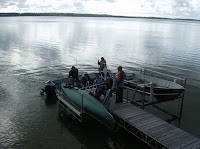
I spent a week (not enough time) at a wonderful cottage on Manitoulin Island, walked the cup and saucer trail, (in the picture above) sat on the dock, did puzzles and read a lot.
Got back, and I've been immersed in home renovations and arranging some work for this fall. This work project has required that I step into the role of organizer for a group of cutters, so I've been arranging rental space and insurance and thread and all the little things that eat up your time but don't give you many tangible results at the end of the day.
Finally, we are ready to move onwards from the seemingly endless dust and noise of renovation and progressing from emails and designs to costume making.

In addition to the big project that I am working on, I am going to make a jacket pattern for a client I have worked with before. I don't usually take on many private clients, but this is a lovely gentleman who has trouble buying anything that fits. His shape has been affected by some health issues and I feel good being able to use my talents to help someone who is so genuinely appreciative to have something to wear that he feels good in.
I started the pattern today, so I'll show you where I get to as I work toward a mock-up and a fitting. Believe me, when you see the pattern, you'll know why I am doing a toile first.


Thursday, September 10, 2009

pattern drafting breakdown

The breakdown, (and I don't mean what happens when you have too many patterns to make and not enough time) of the process of making something three dimensional (clothing) from something two dimensional (a pattern) is endlessly interesting and challenging.

There are many "systems" for drafting patterns, with the heyday of the written development and dissemination of these theories being the nineteenth and into the early twentieth century.

They developed measurement techniques, standards and even devices to support their drafting techniques/theories. These theories use the standard proportionate male figure of the time as a base point. Knowing that most figures are neither standard or proportionate, the theories then go into great detail about how to deal with the "disproportionate" among the population. People often get discouraged when they realize that the system won't give them a perfect fit for every body, every time. Every system then needs to be adapted somewhat for the individual figure. That is where the pattern maker's eye and experience come into play, in both the pattern and especially the fitting. Eventually you learn what your "system's" benefits and shortcomings are, then you adapt when drafting.

The adapt and adopt method works well for me for a couple of reasons:

One: I am largely a self taught cutter. Now I know that this is unusual and at times I do wish that I had been fully instructed in a "system" but I think that I have been freed up to modify my approach without feeling as though I am abandoning my training. My other formal training in visual arts has proven to be invaluable in my cutting career.

Two: in the theatre we are not trying to re-create period clothing absolutely-either in the cutting or sewing. We have timelines, budgets and designers input, and actor requirements and I think that even when we are trying to do true period looks it is always filtered through our own aesthetic as well as those of the designer, director and the audience.

Well, that's a long preamble to what I hope to post about in the future which is how I approach looking at "systems" for drafting patterns and getting around the three dimensions of the body, using some traditional information as well as your eye and sense of shape and proportion.
Lofty ambitions I think!

Cheers.
p.s. I'm going to be posting at a snail's pace through the fall, but stay tuned.