Monday, August 12, 2013

Making samples

Well, since I last posted, work has been quite frantic, and although my contract has ended, my work was not finished! I could have stayed an extra week but decided that time off with the family was more important. 
I actually hated to leave the work for others to finish but I am sure Denise and Silvia will be fine without me. The garment that was in pieces was a leather doublet for an understudy. The original was made by someone else on the team, so I thought I would make a little sample of how I remember the process for reference.
Sampling for techniques is something we take the time to do when we are figuring out the best way to put things together, or are dealing with a specific fabric or when we change a previous technique. It is a great thing for new stitchers as well. 
Sometimes it is years in between making certain garments so even experienced people find a refresher helpful


In this case, I whipped up a sample since I won't be around to answer questions.
This is a leather doublet, with an interior structure of washed/preshrunk cotton duck. It has spiral boning in a few places to keep the shape from completely collapsing over time. The leather has been pretreated by our resident craftsperson who does surface embellishment and also breaks down the finished costumes. She reduced the shine of the original leather and also distressed it and painted it a bit before I cut it out.

Working with leather is not difficult but you do benefit from having a walking foot leather machine. there is the advantage of being able to use a raw edge with leather- no worries about fraying! You do have to be careful that you do not need to restitch over the same area, because the leather can and will perforate- and letting leather seams out leaves a very visible former seam line of punched holes. So it is best to make a toile and then you limit/eliminate  any changes once the leather is cut out.
The binding at the waist and the skirt are glued on, clipped and wrapped to the inside before being stitched. That line of stitching is top stitched through the binding. The stitch line to attach the skirt is done along the top edge of the binding to eliminate two lines of stitching in the same place.
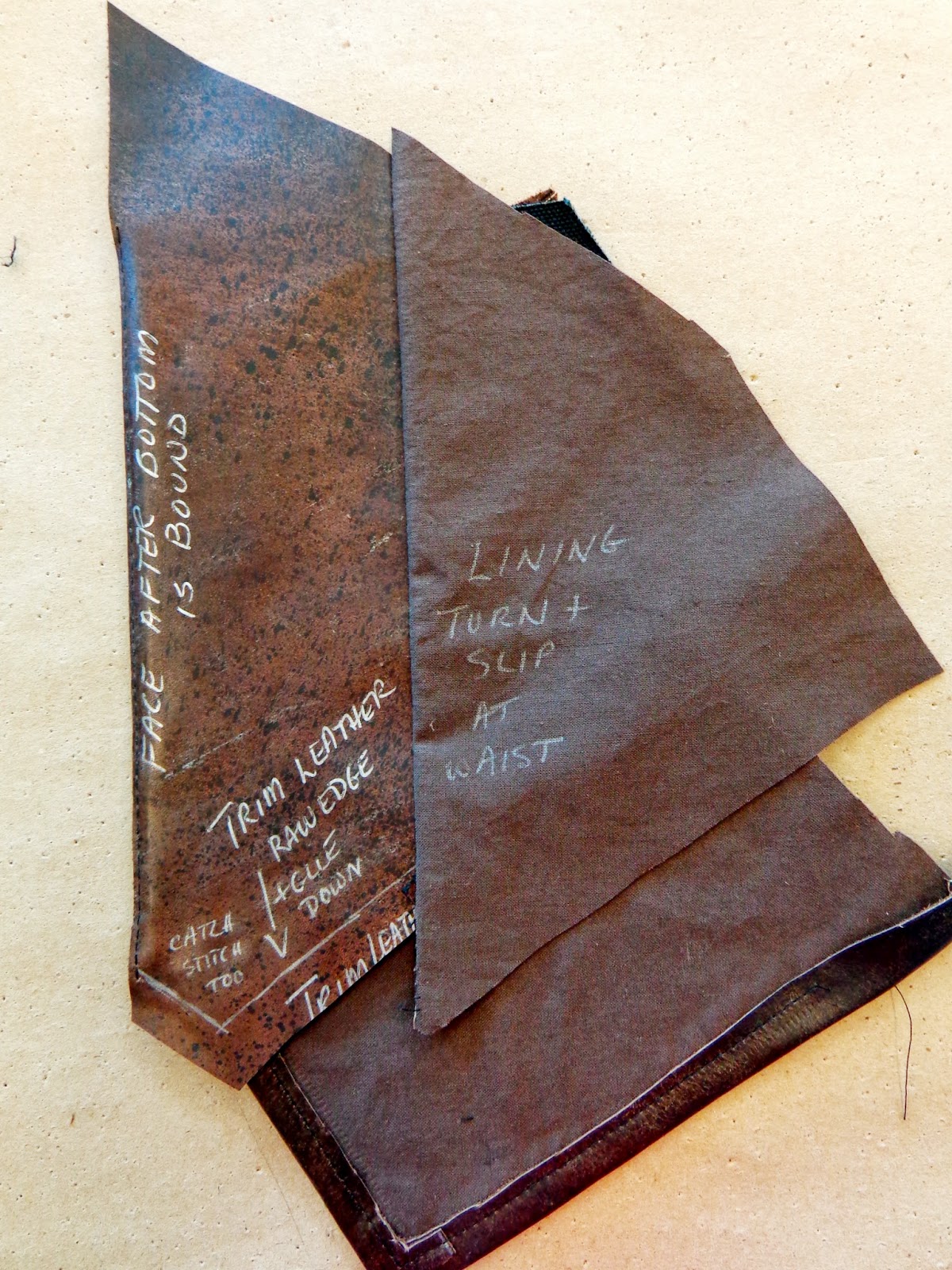

The facing is leather, because we are making simple functional buttonholes, consisting of a stitched rectangle and a cut through the layers of the front. the facing has a raw edge where it is seamed to the front edge- this reduces bulk that a regular seam allowance would create.
We are lining this doublet, because it is worn open. The lining at the waistline will be finished last, by hand.

As you can see I have written all over it for reference, and after the doublet is complete, the sample will reside in our sample box, ready to be examined next time we need it.


Now, onto a mini getaway and then my next project which is a bit tentative. It may be that I have some time to do more thinking and more detailed posting. I will have to wait and see.


Sunday, July 21, 2013

Suits: the finishing details


Well, we are reaching the finishing stage for our suits. I thought I would share a few photos of the finishing details here.


Marking the lapel buttonhole, ready to go to the machine. You can see the way the under collar has been hand stitched onto the jacket and how the collar end has been finished
Here is a view of the inside of the back neck. I cut two piece top collars nowadays because a lot of the fabrics we use don't respond to being stretched and shrunk. This one actually is a stretch wool! A challenge to work with, but if carefully handled you get results like this.


A close up of the finished jacket front.
Here is a view of the top collar of a linen jacket, nicely matching at the centre back. This one had top stitching details on the patch pockets and the front edges.
Front view


Back view.


Here is a silk, linen and wool windowpane check jacket with a notch collar and patch pockets.
This one turned out very nicely. I am not sure how well it will stand up to wear and tear, but for now it looks great.
This one needs a final press and we don't have a stand that shows it well. Wait! did I forget to put the lapel buttonholes in?
No, I think they're in, just very subtle. DB in a tone on tone stripe wool. I guess I will check the jacket tomorrow just to be sure.
This one is one of the last minute additions, in the fitting it went from a two button to three ( good thing we hadn't taped off the roll line and had the front edge still basted! ) a ticket pocket was also added at that time. This is a black wool tone on tone herringbone stripe. These shoulders have a flatter look that the other jackets, the seam allowances have been pressed open at the shoulder/crown of the sleeve, to give less shoulder expression. They have just a little sleeve head of soft lambswool instead of a canvas sleevehead.


Tomorrow, we have to get the last jacket wearable for Tuesday, finish a couple pairs of trousers and get back to finishing our doublets and robes which need to be loaded out by Friday. It will be another busy week, and I am looking forward to the deadlines being over!

Friday, July 5, 2013

The best laid plans or where is my fabric?

Tuesday morning arrived, and I was ready to start right in on cutting that three piece suit that was added to my workload.
Well, you know how things go when you are under the gun, not much time left....of course the fabric that was shipped was not what was ordered.
Change of plans for Tuesday, so the fabric was reordered, and I changed focus to the period costumes that  needed my attention. Wednesday came and went. Thursday at 2 p.m. the correct fabric arrived! So off it went to be pressed and bolted and I started cutting. At the end of the day I had the trousers and jacket cut, today I cut the waistcoat and the little bits like pocketing and welts and the like, and by the end of day Monday, we will have the suit basted up and ready for a fitting. A bit of teamwork makes it all possible: someone makes up the sleeves and back, someone else the fronts, someone else is making the trousers and a fourth person is basting up the waistcoat. Once the fitting is over, one person will continue with the jacket, one the waistcoat and a third on the trousers. Then I will also be able to cut the second suit, and hope that after the first one, I should have minimal alterations.

In the meantime, I had a couple of fittings and we can now go ahead and finish many things, such as these trousers. They have the main components installed, but the waist, hems and CB seam are just basted for the fitting.

 There's a lot going on in these trousers.
They are double reverse pleated, with slanted or quarter top pockets, with a grown on waistband. They have two back pockets, and they finish with cuffed bottoms. They will  also get belt loops, set down from the top edge by a half an inch for a narrow belt.

It is interesting what the camera picks up, and I can see that the left pocket edge is smooth and the right side shows ripples. It wasn't apparent to me in the fitting, but I can guess that it is the effect of directional stitching. On one side the stitching was done from top to bottom and the other from bottom to top. In a twill fabric like this, it can be just enough to cause this effect. I will have to hang them vertically to see if it shows up then.

A quick peek on the inside reveals the back pocket bag finishing as well as the inside waistbanding.We finish the waistband and centre back of trousers differently than commercial trousers to make it easier to alter when pulled from stock. After all, once the show is down, they go into stock and may be used over and over on different people.

Saturday, June 29, 2013

A morning's work drafting

 We had a late addition to my workload, so I headed in to work this morning to do some drafting.
I get so much done when I am alone in the room.
No interruptions!
I started the trouser pattern late yesterday afternoon, and finished it up before I started in on the waistcoat and jacket pattern.

I started with my basic grid set up, and draft to the measurements I have- then I modify where I think it is needed. In this case I am dealing with an eight inch chest to waist drop and a drop of five inches waist to hip. So a bigger broader chest and slim hip size. I made a little modification in the back   length as well splitting  the back and opening it up for a bit of a forward head/neck.

The jacket starts with my grid set up as well- and I made a mistake  in my set up, forgetting in a moment of thinking too fast that I had added seam allowance. So something looked odd.  I say it over and over to other cutter's apprentices and stitchers that if something looks wrong it probably is,  so stop and retrace your steps.
I was drafting in pen to try to make it visible in photos, so you get to see the mess I made!
A bit further into the process, I think on paper, at this stage I change my mind and the lines as I make adjustments on the fly.
I made a further adjustment after getting the pattern cut out, I needed to create a bit more breadth in the upper chest area only.
I had to leave at noon, so I left it to percolate around in my head for the rest of the week end. The fabric should arrive Tuesday morning and I need to put the scissors to it right away.

Sorry about the photo quality, had to be quick about it all and of course the camera battery chose today to run low!

More later.....

Thursday, June 27, 2013

Not only suits being made

 Well, things have been very busy at work and we are not just making suits, we have some period costumes to put together or refurbish from stock.
These are some of the costumes we've been working on.
A pair of suede trunk-hose. These are built on a fitted under base of twill. This year we are trying a few new techniques for putting these together. The lower leg or canion of suede is flat mounted onto the twill pieces before the legs are put together.   We constructed the fly completely into the under trouser, which allows us to construct the upper suede pouf separately. The pouf is attached to the thigh first, then brought up and attached to the waistline before the waist band is sewn on.
 The centre front opening in the suede is faced back to the fly notch with a cotton twill tape, and that will then be slip stitched to the fly opening of the under trouser at the end. We figured that by doing it this way, we can remove the pouf if required, make changes to its size, add under structure if needs be without too much trouble. So far so good.
We are also making a doublet that has suede sleeves. These are in cowhide and have decorative ridges sewn down the top and under sleeve. We were able to create a similar look on the seams themselves by stitching a regular seam , pushing all the seam allowance to one side then top stitching a quarter of an inch away- like flat felling- then opening up the original stitch line so creating a similar ridge effect. Luckily we have access to boots and shoemakers and their equipment, because the last seam had to be done on the post bed machine. It makes top stitching inside the tube of the sleeve possible.

Lastly, what is a season without a large robe? It seems I get one every year. Last year was the velvet robe completely lined in fur. This year we have a large scale silk damask, lined in silk duppioni. What isn't in the photos is the waist length capelet of the same fabric lined in....you guessed it, fur.

It is time consuming and sometimes stressful cutting out these large garments. Often I have made a pattern and done a toile fitting without knowing what the fabric will be. So without knowing the fabric width or the size of the repeat, I often have to alter the pattern to fit the yardage I get. 

Anyway, I guessed pretty close as I didn't have to modify the pattern, but it takes a good amount of time to lay out the pieces and make sure that the pattern placement overall is good and the pattern matches at the sides, and that you will have enough yardage overall. Garments like this have to be cut in a one way layout as there is a definite up and down to the pattern. This produces a lot of waste as you cannot top and tail the layout. I also lose a half vertical repeat when I cut the yardage so I can lay the fabric right sides together to cut. This fabric is meant for drapery so it is woven with a half of the pattern ending right at the selvedge edge. I prefer to not use the selvedge as my seam allowance, so I lose then lose a half repeat horizontally, as I lay the centre front and centre back in the middle of the next pattern repeat from the edge. Hope that makes sense.......


Under the cape is an under gown of red velvet brocade with a really nice hand. It is a little bit tricky sewing it together and trying to match the pattern as the velvet pile comes and goes along the seam. I think it is easier to sew plain velvet.
The trick according to Denise is triple rows of pinning. One row of pinning on the sewing line and a row either side to prevent shifting. Oh, and using the narrow velvet foot on the machine. Even then it can be a challenge!


This will be fit tomorrow, so I will try to get a photo of it all together next time.


Thursday, June 6, 2013

Back to making suits

I had been working on a post to describe my job, but I was having a hard time writing it down in some kind of blog friendly manner. I think it will have to work on it a bit longer. The working title is "There is no Formula". I think I should get a plaque that says that and mount it on the door to our workroom. :)
Anyway, I haven't given up on writing it, but it will take some time to do.


So, instead, I will show you what I have been up to lately.
I am still in the land of the 16th century and making doublets and trunkhose- a pattern for a doublet toile is in the top photo.  We had a fitting of the toile and I am in the middle of marking the pattern alterations. This one will be made in leather- just waiting for the designer to buy it.


In addition to the 16th century, I get to jump ahead to the 20th century and make a few 1930's suits.
Hurray!
I have some great style and cutting references for this period in my collection, and I was happy to put them to good use.
We will be making seven suits for three different gentlemen, and the first one off my cutting table is this one in linen.

This is the real fabric, basted together like toile- so the pockets are not in, (I usually just thread mark the breast pocket placement, but Susy put together a little fake welt) the patch pocket is just a sample where Susy tried out different thread colours for the possibility of a machine topstitch detail.
The lapels are just quickly basted to the chest canvas, and there are generous inlays left for possible alterations. Luckily, I measured this guy myself so I was quite sure of the numbers, and it all went well in our fitting- not many changes at all.  The sleeves need to be lengthened, and the designer wanted a peak lapel, instead of the notch lapel I was trying to sell her. Other than that, we are good to go ahead, finish this one and get started on the other three for him.


 The trousers are high waisted, double pleated, with slant pockets, a grown-on waistband, and cuffs. They are lined in the fronts to just below the knee, and still need back pockets installed. For some reason I marked them an inch lower than they should be- slip of the ruler I guess- good thing we didn't put them in!
They look tapered from this camera angle but they are about 19  inches at the hem, wide, but not overly so. The hem width needs to work with the person's height and shoe size as well as the style of the period.


Sunday, May 12, 2013

A few finished doublets

 Before I get going on this post, I have to say something about the weather. It snowed today.
Last week the temperatures were in the mid to high 20's (Celsius), and today was a high of 3, with flurries. I am not amused.
 
                                                        I have also been very busy at work, which has tired me out and  on top of that we had a vehicle fire and have lost our VW Westfalia, which has not helped in the staying positive department!
But enough of that talk.

I thought I would show you a few finished items today, two doublets and a variation of trunk hose that I am quite happy with.
The brown doublet is quite a large size, I think a 52 chest if I remember correctly. I wasn't expecting this trim as it was not indicated in the drawing I was working from, so it was a surprise when the designer wanted it.
I had already cut the body out when that happened and I was fortunate to be able to accommodate the trim placement in the existing body panels. The unfortunate part for the budget was that it had to all go on by hand, for a few reasons- One: the backing and structure under the fashion fabric was boned and the fabric had already been mounted to the backing, - Two: the trims were wobbly and needed to be basted in place over a ham so they wouldn't be too tight- Three: one trim was quite open and the other was velvet that crossed over the other, and machining looked like it was going to get tedious. The original though was double lines of trim, but that would have been almost 75- 80 metres of trim, so instead it has single lines and 35 -40 metres of hand sewing. Denise and Karen's fingers were very weary by the end of it all. The sleeves eventually got small ruffs as well- sometimes the opportunity to get a picture of anything totally completed eludes me!

The "trunk hose" that goes with the doublet is an interesting adaptation from an idea that another cutter had on a stand. Instead of building separate panes for the trunk hose, the paned look was created from the main fabric. I marked out the "pane" placement, and cut felt in the shape of each pane. The felt pieces were laid on the fabric and the edges were wrapped and top stitched. The fabric in between the pane area was then gathered and distributed behind the panes which creates the effect of depth. It was very lightweight and effective as well. They are built upon an under structure trouser of lightweight drill, that I fit first. The fabric on the canions was applied first, then the paned piece was stitched on at the lower level, along with some shape support (gathered crin), before being brought up to the waist, where the waistband was stitched on through all the layers. That was a very short description of a complicated process!

Next, we have a suede doublet with contrasting sleeves of striped silk. This was a fun project, marking in all the detailed slashing lines. The suede is a bit soft for this kind of project in my opinion, so it will be interesting to see what it looks like after being worn for six months. We opened up the slashes a bit by stretching one edge with our fingers, like fluting pie crust. The sleeves are bound off separately and then attached into the armhole which is finished with a clipped binding and a second clipped piccadil style wing.

This last doublet is the finished result of the muslin I posted about here. It was supposed to look like two garments, the front edge of the grey is loose and the two are sewn together along the piped seam. It also needed a pocket for a letter, which we found out as we were well into the finishing stages, so on the left side we opened the seam between the two "garments"and added a stay piece of cotton that connected with the side seam and also enabled us to create a pocket bag there, without compromising structural stability.

Whew!


So, what is next you ask?
I have a couple of doublets and breeches to make for understudies on a show I didn't work on in the first place, so that is well underway, and later on I should be starting some suits! Hurray! some regular (1930's-40's) tailoring, and I am looking forward to it.
There may be a doublet or two thrown in for good measure, but I can't wait to make some suits.