Sunday, May 12, 2013

A few finished doublets

 Before I get going on this post, I have to say something about the weather. It snowed today.
Last week the temperatures were in the mid to high 20's (Celsius), and today was a high of 3, with flurries. I am not amused.
 
                                                        I have also been very busy at work, which has tired me out and  on top of that we had a vehicle fire and have lost our VW Westfalia, which has not helped in the staying positive department!
But enough of that talk.

I thought I would show you a few finished items today, two doublets and a variation of trunk hose that I am quite happy with.
The brown doublet is quite a large size, I think a 52 chest if I remember correctly. I wasn't expecting this trim as it was not indicated in the drawing I was working from, so it was a surprise when the designer wanted it.
I had already cut the body out when that happened and I was fortunate to be able to accommodate the trim placement in the existing body panels. The unfortunate part for the budget was that it had to all go on by hand, for a few reasons- One: the backing and structure under the fashion fabric was boned and the fabric had already been mounted to the backing, - Two: the trims were wobbly and needed to be basted in place over a ham so they wouldn't be too tight- Three: one trim was quite open and the other was velvet that crossed over the other, and machining looked like it was going to get tedious. The original though was double lines of trim, but that would have been almost 75- 80 metres of trim, so instead it has single lines and 35 -40 metres of hand sewing. Denise and Karen's fingers were very weary by the end of it all. The sleeves eventually got small ruffs as well- sometimes the opportunity to get a picture of anything totally completed eludes me!

The "trunk hose" that goes with the doublet is an interesting adaptation from an idea that another cutter had on a stand. Instead of building separate panes for the trunk hose, the paned look was created from the main fabric. I marked out the "pane" placement, and cut felt in the shape of each pane. The felt pieces were laid on the fabric and the edges were wrapped and top stitched. The fabric in between the pane area was then gathered and distributed behind the panes which creates the effect of depth. It was very lightweight and effective as well. They are built upon an under structure trouser of lightweight drill, that I fit first. The fabric on the canions was applied first, then the paned piece was stitched on at the lower level, along with some shape support (gathered crin), before being brought up to the waist, where the waistband was stitched on through all the layers. That was a very short description of a complicated process!

Next, we have a suede doublet with contrasting sleeves of striped silk. This was a fun project, marking in all the detailed slashing lines. The suede is a bit soft for this kind of project in my opinion, so it will be interesting to see what it looks like after being worn for six months. We opened up the slashes a bit by stretching one edge with our fingers, like fluting pie crust. The sleeves are bound off separately and then attached into the armhole which is finished with a clipped binding and a second clipped piccadil style wing.

This last doublet is the finished result of the muslin I posted about here. It was supposed to look like two garments, the front edge of the grey is loose and the two are sewn together along the piped seam. It also needed a pocket for a letter, which we found out as we were well into the finishing stages, so on the left side we opened the seam between the two "garments"and added a stay piece of cotton that connected with the side seam and also enabled us to create a pocket bag there, without compromising structural stability.

Whew!


So, what is next you ask?
I have a couple of doublets and breeches to make for understudies on a show I didn't work on in the first place, so that is well underway, and later on I should be starting some suits! Hurray! some regular (1930's-40's) tailoring, and I am looking forward to it.
There may be a doublet or two thrown in for good measure, but I can't wait to make some suits.

Saturday, April 20, 2013

More ruff construction


I have been grabbing photos here and there during the construction of the ruffs.
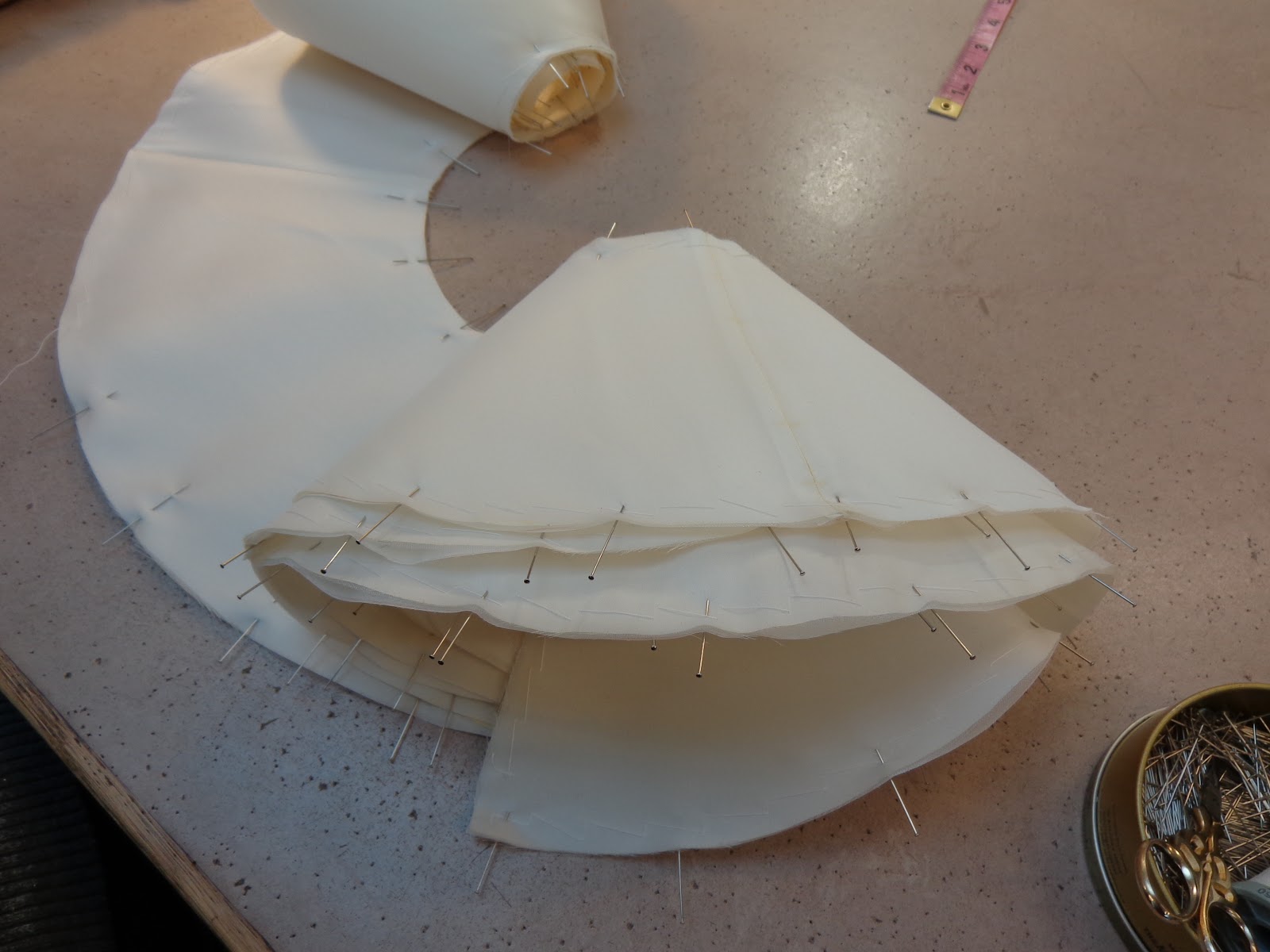
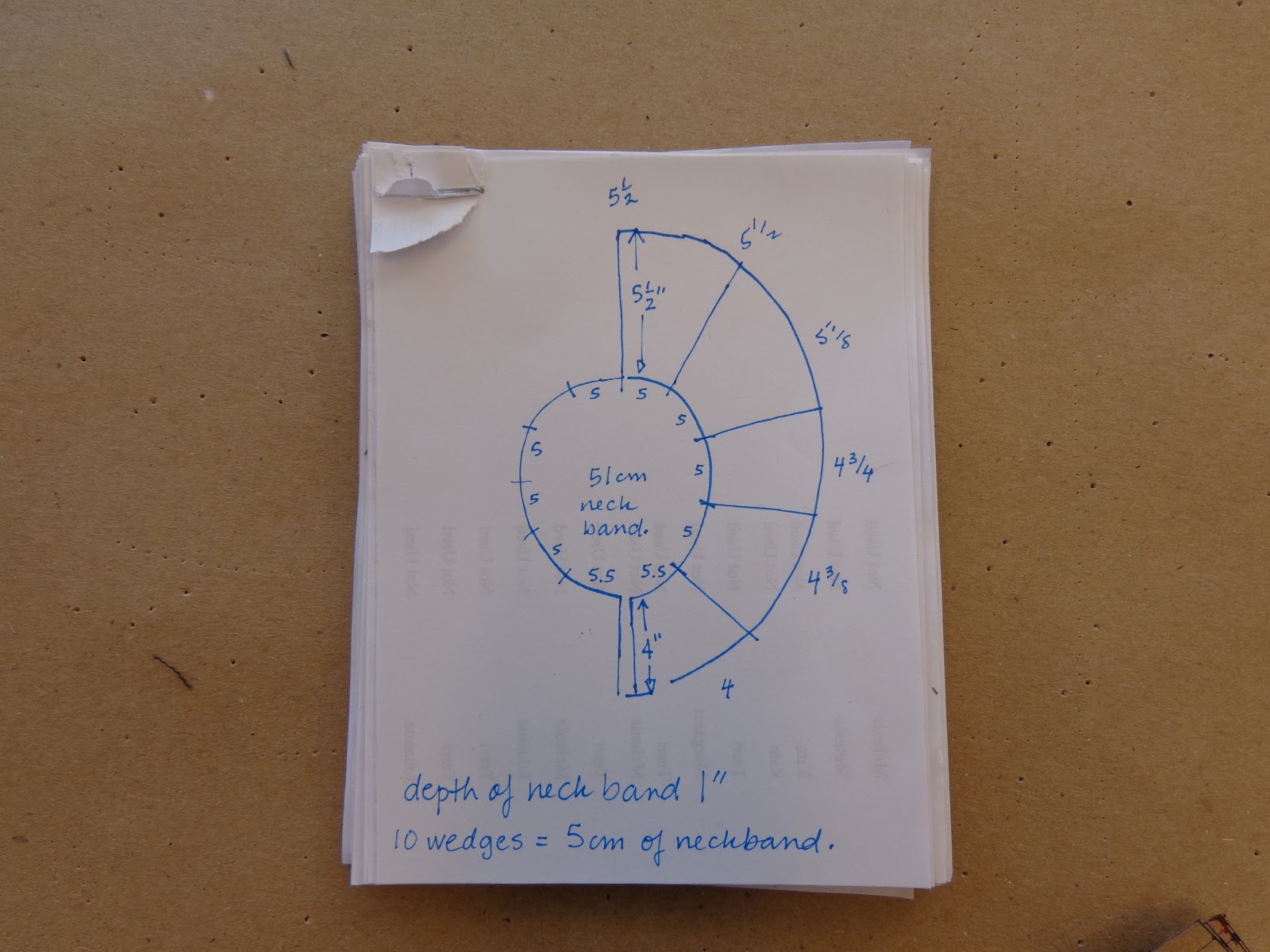
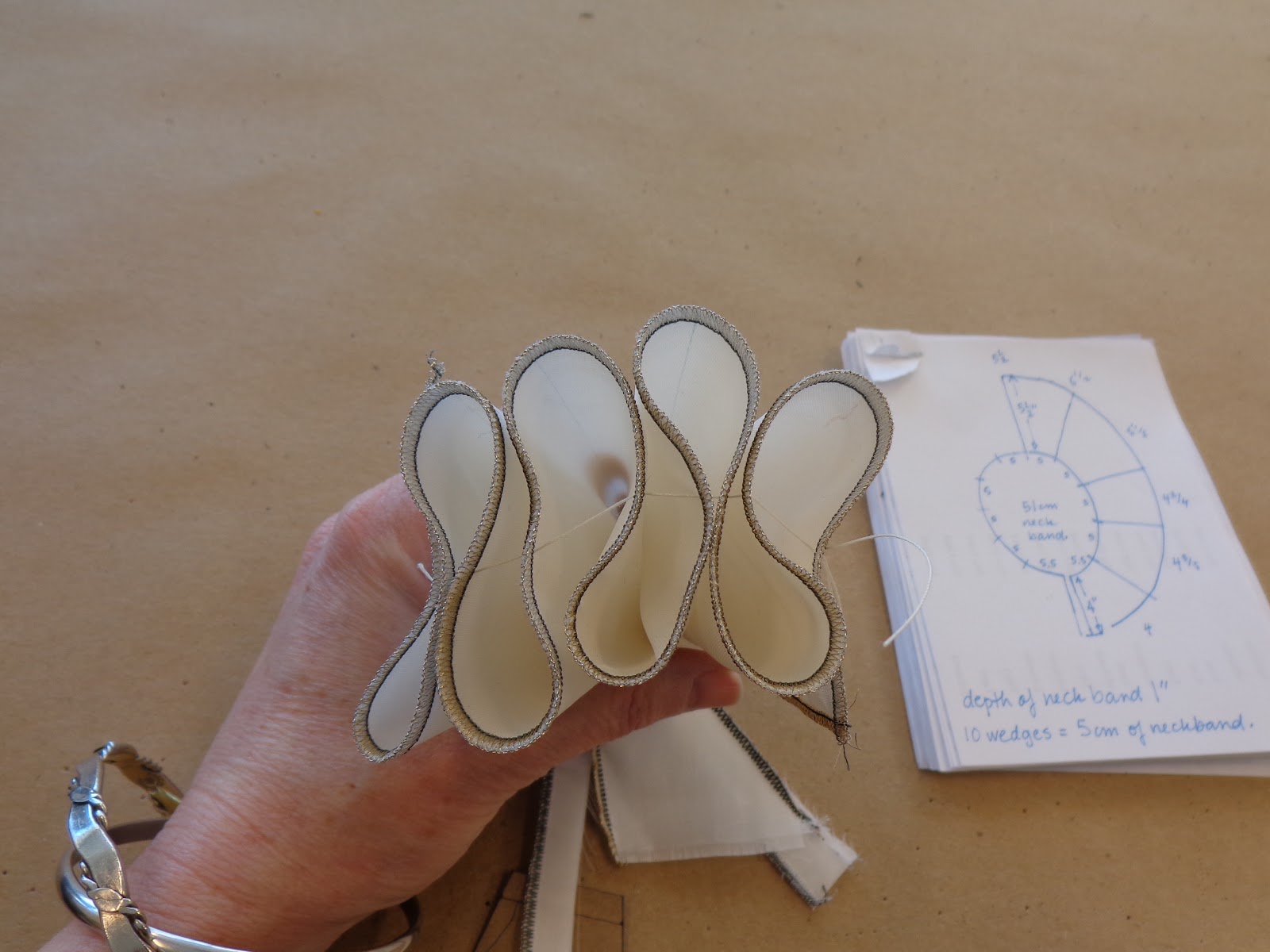
The top photo shows another ruff being laid out on the original pattern so that the markings for the folds can be made. Once all the circles have been marked (I think I cut 11 circles for this ruff), the next step is to thread a needle with a heavy thread- we use a button thread (Coats and Clark  Dual Duty Plus) and stitch down through one mark and up through the next to accordion pleat the ruff.
Tie off or wind the thread ends around a pin and then start sewing the inside edge of the ruff to the prepared neckband. You can see the stitches in the second photo. Sorry, I didn't get sewing action photos during the construction of the ruffs.


The third photo is another circular ruff we made. This one is in black linen with the same crin as a support structure. The difference here is the edge finish. This one has a piping edge, so that entails finding a fine cord - we ending up using yarn- inside a folded bias to make the piping first. The crin was stitched to one layer of the linen, then the piping was sewn to the edge, then the second layer of linen was used to "bag out" the outside edge. The tedious part of this process is the trimming and the pressing of the seam allowances along the outside edge, and then edge stitching the seam allowances down before you can join all the layers on the inside edge. You need to be careful to cut the one set of circles that form the top layer just outside your drawn line thereby making them just slightly larger, because you have to allow for the turn of the cloth taking up an incremental amount of the fabric.  The piped edge does make a beautiful finished edge to the ruff, but it also adds almost a days work compared to the sewn edge finish. The bottom photo is our spiral ruff in place on the doublet. I think I may need to provide a little supportasse at the back to make sure it doesn't ever flop downwards at the back due to its size.
The ruffs are snapped to the collars of the doublets so they can be removed for dry cleaning and other maintenance such as make-up removal.
I have also made straight ruffs that had a softer fabric sewn to the inner circle to allow them to come from the inside of the doublet collar, so there can be many variations on the theme.

Tuesday, April 16, 2013

Ruff- moving onwards


 The ruff continues..........

Jumping ahead! The sandwich of silk and crin was basted together, then machine stitched to hold all the layers securely.
The outside edge was finished with a baby lock edge in metallic thread, silver on one side and gold on the other. The 1/4" seam allowance on the outside edge was cut off in the process.

The inner edge of the circle is not happy to be serged, and believe me, we tried. It was easier to use the industrial zig, and sew a very close zig over the machine stitch, then cut off the seam allowance by hand. A bit tedious, yes, but less
tedious than fighting with a serger!

After the edges are finished, marks must be made for gathering the edges into the figure eight formation. For this ruff, we knew that each section was cut to be 10 wedges, so the sections were remeasured and compared to the original pattern. The outer edge had stretched ever so slightly as may be expected with circles (bias). We decided to divide the sections into ten to maintain our plan, and marked both the inner and outer sections accordingly. Then, by hand with a strong thread, pick up those marks and create an accordion fold of fabric. Secure the thread, set aside and admire!

The next step is to prepare a neckband. We used two layers of grosgrain ribbon so it had some inherent strength. This is also a good time to sew snaps to the neckband, because it is irritating and awkward to sew them on later.

Once that is prepared, mark the neckband top and bottom edge every 1cm ( that is our chosen spacing), offsetting the marks on one edge by half.
For this particular ruff, K started setting the ruff to the band at the centre back. I had cut an extra four wedges at the front as insurance and I wanted the ruff to be symmetrical from the back. once we fit it to the garment, we could remove any extra.
 In even sized ruffs- that is with a single depth overall, you can start at one end and make your way to the other, but a good rule of thumb is to cut just a bit more than you think you need, because it is nothing to cut away excess, rather than trying to add more in.

Almost done by this point!

Thursday, April 11, 2013

Ruff, second post

 I have to say that it is difficult to get photos of the ruffs being made. I get something cut, then voila, it is being sewn together and I am cutting something else.

Here, I caught a quick photo of K- sewing together the Crin interlayer of the ruff.  This is the substance that will give the ruff structure. The Crin and the silk are cut exactly the same, there is a 1/4" seam allowance left on the inside and outside of the circles, that will get cut away as the edges are finished.
 The Crin is seamed by overlapping the seam allowances and stitching through the layers, just to keep it as flat as possible.
The silk layers are seamed together with a scant 1/4" seam allowance. The joins between the sections are carefully marked to prevent confusion.
Once all three layers are seamed together, the task of sandwich making begins. I was careful to make sure all the sections had matched grain lines, so the circular aspect was maintained.
The three layers are pinned, then basted together by hand. You can see the basted section being rolled up as K bastes. It is very important to keep the length under control while you are working on it.
After they are prepped, K will overlock the outside edge with metallic thread, and satin zig stitch the inside curved edge which is what will be sewn to the neckband. The inside curve is zigged and cut away by hand. We tried numerous samples trying to overlock the inside edge, but it wasn't working very well, so zigging was the next obvious finish.

Ok, off to cut something else, actually another ruff, then a cape, and some sleeves and a waistband, a collar, as well as some pockets for a variety of items, and talk to boots and shoes about sword belts ....well, you get the picture- it is busy!


Thursday, April 4, 2013

Figure Eight Ruff

 One of the things on our to do list is making a large figure eight ruff.
 It has been a few years since we made one, but luckily Susy had kept samples from the last time as well as notes that she took during a mini course with a colleague. We actually have three figure eight ruffs to make, all slightly different, from black linen with a piped edge to this large graduated one.

This particular ruff was requested to be made specifically to these dimensions. The size at the neckband should be 2.5cm. The size on the outer edge (the figure eights) should be 7cm. The depth at the front should be 4 inches and gradually increase to a depth of 5 1/2 inches at the centre back.

The edge was to be baby locked in metallic thread.
The fabric is a satin weave silk organza. For structure, Susy made a sample with  an inner structure of heavy nylon crin. Odette 611 from Fucotex to be specific.

So I divided the neckline into sections and determined the depth of each section. I made five different "wedges" to correspond with those depths. I then figured out how many wedges would be needed to fit into each section of the neckband and drew them out as partial circles.
Once that was done, I taped the sections together and modified the outer edge so the 4 inch wedge section would blend into the  4 3/8" wedge section gradually, all the way to the 5 1/2" section. In other words when it was all taped together it was a spiral.
So far so good. Triple check everything. Once you start there is no going back.
Well there is, but it is messy, disheartening and time consuming. So I walked it through with the team, asked them to ponder anything I might have missed while I went to lunch before I started cutting out all the layers.
First- cut all the structure fabric, which is stiched together into a spiral. Then cut all the fashion fabric- double- a layer for the top and one for the underlayer. They will all be stitched together,  into spirals, before they are all sandwiched together.
Pictures to come.


Friday, March 22, 2013

Costume designer: job description

It has come to my attention that a description of the various jobs in the theatre wardrobe is in order.

I am referring to the large theatre setting and to some degree regional theatres in Canada. There is likely some difference in other countries, and some differences for film and television work.

So, lets start with the costume designer.

Contrary to what most people may think, the costume designer doesn't make the costumes.


The costume designer is most often chosen by the director of the particular show. Designers may be suggested by an artistic director or production manager, based on the designer's previous work or a designers affinity for a certain style of design that may be just the right thing for the show in mind.
As such, the designer has to be a conduit for the director's vision for the show.

People Skills. The deigner must have good interpersonal skills to work with many people; from the director, the actors, stage management, publicity, the wardrobe, to the fabric store employee.
Research.The designer must be able to read the script, making note of all the different characters and their possible costume changes and requirements in accordance with the directors vision, the plot, and the budget.
They also must research the era the play is to be set in, the clothing styles, the social etiquette, the historical goings on that may need to be reflected in their design.
Drawing. A designer needs to be able to convey the idea for each character in the show in a sketch. It is how they communicate all of the research and discussions that they have done up to this point. This sketch is what they will present to the director to illustrate how the characters will look and fit into the overall vision.They need to present colour drawings or swatch fabric samples to illustrate the colour palette.
The drawing is also what is given to the costume cutter or tailor so the design is interpreted into a pattern which can then be made up.
They have to make decisions not only on the main costume pieces but also the trimmings, undergarments, shoes, hats jewellery, eyeglasses, hairstyle, and makeup.
Sourcing. Designers need to be able to find fabrics for costumes to be built, purchase clothing online or in stores, or find rental costumes. In some cases, designers must also know a variety of costume makers who can work on their project, if there is not an in house team. If they are purchasing fabrics they need to have some feel for how fabric handles and what kinds of fabrics are suitable for different garments.They need to have a basic knowledge of yardage requirements for different garments.
Fittings. Designers need to be able to make decisions in fittings with the cutter in regards to style lines and proportions, or if using stock or bought pieces, be able to decide if they fit into their overall plan. They have to choose shoes, accessories, trimmings, jewellery etc.
They also need to be able to interact at the fitting with the actor and be able to convey the vision of their design and speak to any concerns the actor may have.
Rehearsals.  Designers often attend rehearsals so they can monitor any changes the director may be making or if the staging will require a change in their design. They will watch the dress rehearsals and give notes afterwards for any changes that need to be made.
Budgets. Designers usually have to keep track of the money they spend, both in materials and sometimes labour costs as well.
Organization and time management. Designing a show is a lot of work, and the more organized a designer is from the start, the less stress getting to the end result. There are always delays and setbacks, which cannot be anticipated so organization is the key to keep from getting bogged down or impeding the process.

Hmmm.....I am sure I have missed a few things so I may add them in as I think of them.
The next job description will be that of the Cutter.


Saturday, March 9, 2013

Designer decisions

In the early days I thought I wanted to be a designer. I guess that is because no one talks about all the other jobs like seamstress or tailor or pattern maker or cutter, so they are invisible. The designer gets all the glory!
It is a very collaborative process and as I discovered, I was much more suited to the technical side of things.
So, even if the designers get all the glory and recognition, they also have to make a lot of decisions that the very same public never think about because the process is so hidden.
In the case of a period show, the decisions increase at an exponential rate. It isn't enough to just choose the fashion fabric and a lining anymore. Some designers are very specific about all the details in their drawings, others are not.
Take for example this doublet. I cut a half in muslin to illustrate some of the answers I needed to move forward.

 It is supposed to look like two garments but really is one. When I first talked about it with the designer, I made a few notes but didn't have much time for in depth thought about how it all would work, but once I started into making the pattern, I had a lot of questions.
So,
1. how does this garment close?- it wasn't indicated. options are CF meets edge to edge and it closes with hooks and loops, it has functional buttons (need buttons) and holes, or it has a faked closure like a zipper underneath and a decorative placket (need decor trim or such) to disguise the zip.
2. the centre front panel will either extend fully under the front or will just attach into one of the vertical seam lines- I think less bulk is better, so into a vertical seam just in front of the armhole.
3. that means the second panel has a free edge so that means it needs to be lined in something(need lining choice), and what about its finished edge? Does it need something like a trim or a piping (need trim or fabric)to help define the edge and further give the idea that it is a faked separate garment?
4. speaking of vertical seams, the fabric is a brocade. Those requested vertical seams are going to get lost. So I mean if you are making a design feature of them, they need some definition- and what is it? piping?(need fabric) if it is trim, has it been chosen?
5. that leads to the tabs at the waist. They need a lining fabric. How are they to be finished? Plain and bagged out? piped (need fabric) or bound edges(need fabric)
6. do the tabs overlap at the waist or meet edge to edge?
7. is there a centered tab at the centre back or do two tabs meet?
8. Do you want the body seams to co-relate to the tabs? that decision dictates the seaming position on the body.

9. if the over garment doesn't come right up to the neck point, as it didn't in the sketch, I have to show a bit of the under garment fabric at the back neck area. I also have to be able to attach the two things together somehow, so that means either making the underpiece like a yoke that I can attach to the seaming or I have to attach it around the neckline so something like a piping edge would be useful (see point 3)
10. the shoulder wings- are they short like this or do they continue all around the armhole as they sometimes do?
11. Do the wings get any kind of edge finishing? Same as the waist tabs?

Have I missed anything?
oh yes, things I don't have pictures of
12. sleeves-do they have a decorative treatment on the seams? (need decor)
13 do the sleeves close with buttons(need buttons) or a plain placket.
14. are there decorative cuffs? (need fabric) do the decorative cuffs have any lace trim?(need lace)
15. is there a decorative collar or ruff? (need fabric, and possibly lace)
Wait!
16. a cape too. With a collar. Is it lined?(need fabric). Need ties (find cord of some kind)

After I get all these decisions, I still have to make and fit a mock-up, make fit and stylistic changes to the pattern that are required, then determine the support needed for the fabrics the designer chooses, all before cutting it out and having it made up.

So it isn't as simple as it looks and you can multiply these decisions by X number of costumes and then some as the ladies wear will often have a few more decisions to be made concerning understructure to give the correct silhouette and  probably more decoration.
Then there are decisions to be made for wigs and millinery, footwear and jewellery and somehow blending in stock costumes to the design.
This can be overwhelming, especially to designers who have never dealt with a large period show.

They work hard for their recognition and glory :) wouldn't you say?